Birds of Prey
Great Horned Owl
Bubo virginianus
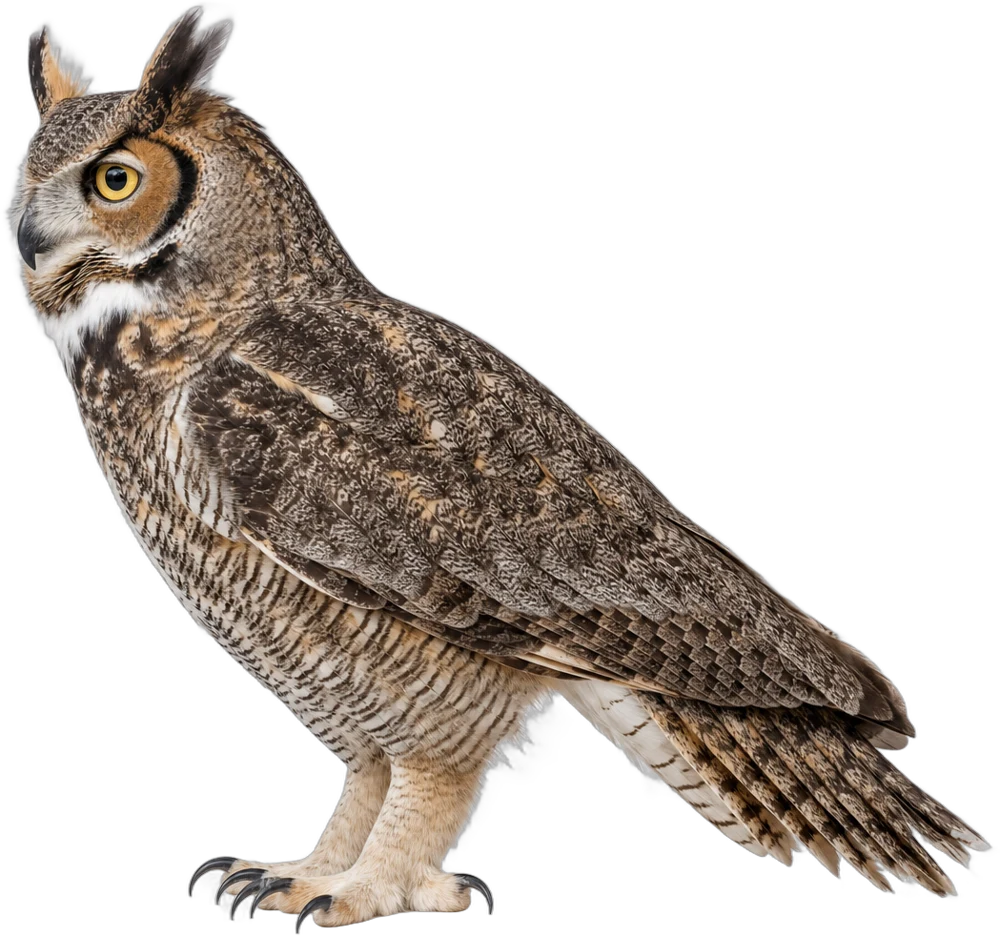
A large, powerful owl with feathered "horns" that lives almost everywhere in North America. It starts nesting in the middle of winter.
How to identify it
- Large owl with prominent ear tufts
- Bright yellow eyes
- White patch on the throat
- Gray-brown, finely barred underparts
- Deep hooting "hoo-h'HOO-hoo-hoo"
SizeBetween an American Crow and a Canada Goose
American Crow19 in
Great Horned Owl22 in
Canada Goose37 in
Great Blue Heron46 in
6 inAverage length, bill to tail
Details
- Size
- 18–25 in long; wingspan 40–57 in
- Weight
- 2–5.5 lb
- Habitat
- Forests, woodlands, farmland, suburbs and city parks
- When to see it
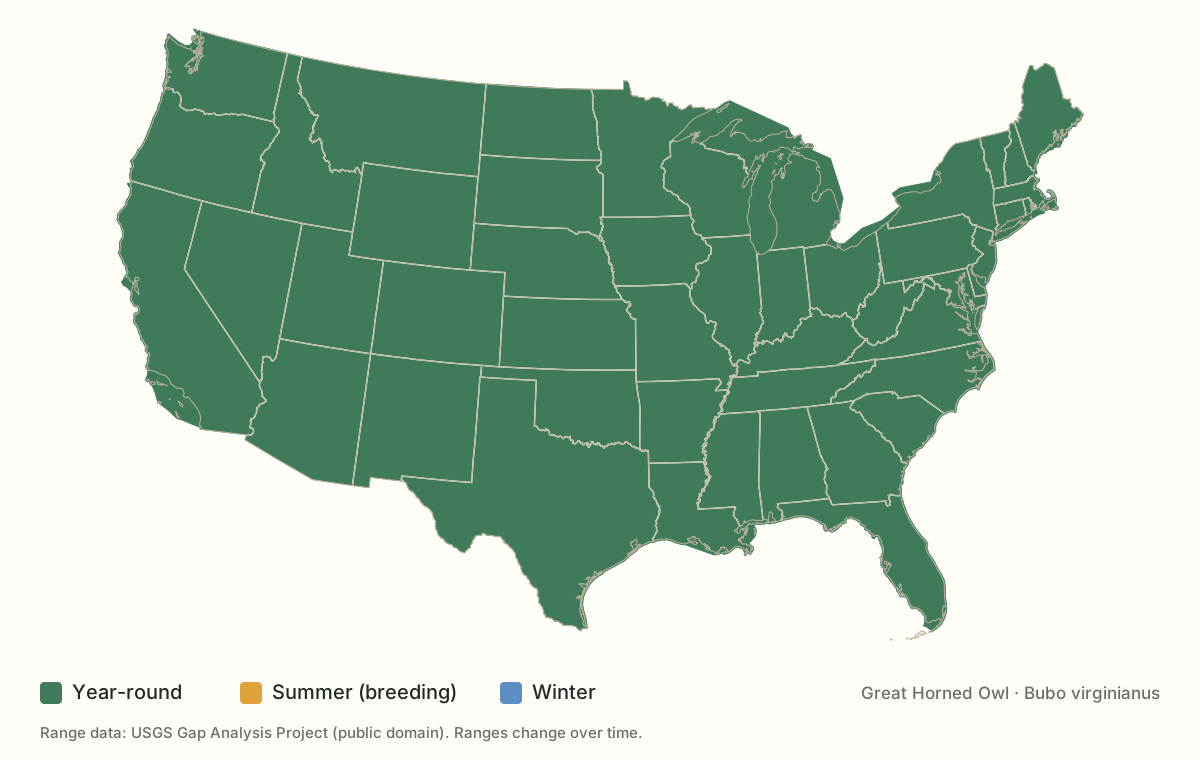
- Year-round across the US
- Diet
- Rabbits, rodents, skunks, birds
Range in the United States
Life history
Food
Takes a huge variety of prey, from mice and rabbits to skunks, ducks and other owls.
Nesting
Usually takes over an old stick nest of a hawk, crow or heron; also uses cavities, ledges and buildings.
- Clutch
- 1–4 eggs
- Incubation
- 30–37 days
- Young
- Leave the nest at about 6 weeks; fly at 9–10 weeks
- Broods
- 1 per year
Behavior
Hunts mostly at night from a perch. Pairs hoot in duets, the female's voice higher than the male's.
Conservation
Common and widespread across nearly all of North America.
Cool facts
- Its grip can take a force of over 25 pounds to open.
- It's one of the few animals that regularly eats skunks.
- It nests earlier than almost any other bird, sometimes in January.
Songs & calls
▶Bird sounds video coming soon
Watch the Great Horned Owl
▶Video coming soon